
Also See: A Guide to Scientific Terminology, and Types of Truth.
The purpose of the scientific method is to provide a structured and objective approach to investigating questions about the natural world, ensuring that results are reliable, verifiable, and as free from bias as possible by following a set of steps including observation, hypothesis formation, experimentation, data analysis, and conclusion; essentially, it aims to gain accurate knowledge through a systematic process of testing and refining ideas.
Ibn al-Haytham is known as the father of the scientific method. He used a cycle of observation, hypothesis, experimentation, and verification. Today it is fundamental to scientific progress, guiding researchers in many disciplines, including biology, chemistry, physics, and psychology.
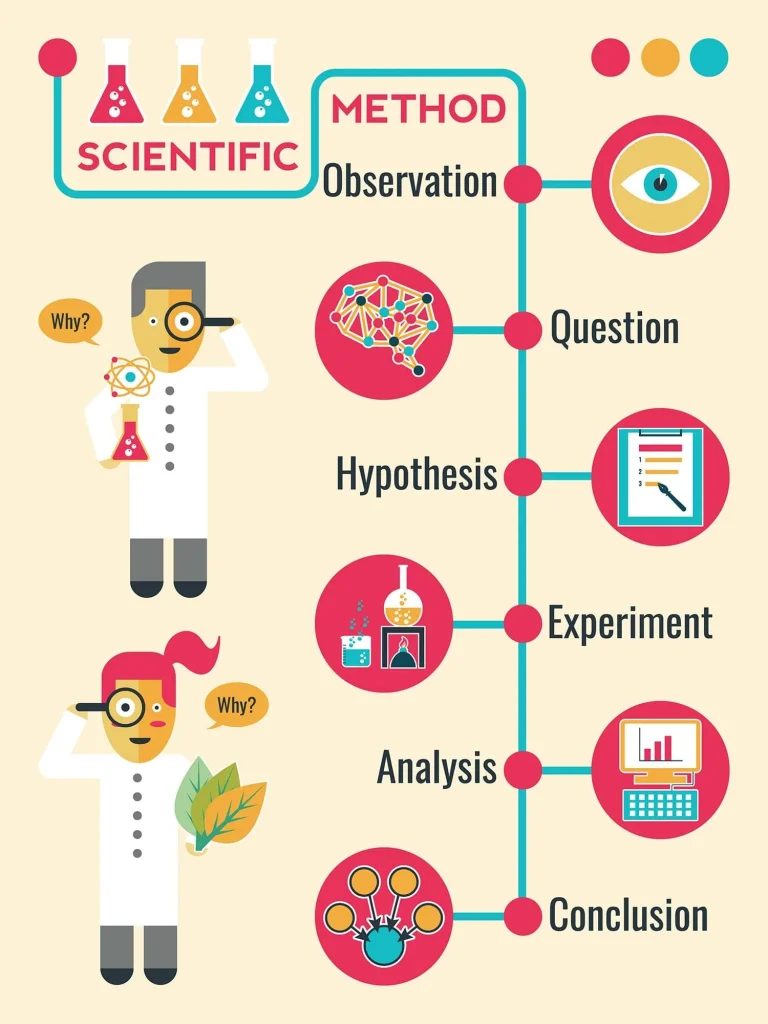
There are 7 general steps.
Observation
The process often begins with observing a phenomenon or identifying a problem that sparks curiosity.
A researcher notices that a specific type of plant grows faster under certain light conditions.
Question
Based on the observation, a question is formed to better understand the phenomenon.
“Does the type of light affect the growth rate of this plant?”
Hypothesis
A hypothesis is an educated guess or prediction that provides a possible answer to the question. It should be testable and specific.
“If the plant is exposed to red light, it will grow faster than under blue light.”
Experiment
An experiment is designed to test the hypothesis by manipulating variables and measuring outcomes. It should include a control group for comparison.
The researcher grows several plants under different types of light (red, blue, and natural light) and measures their growth over time.
Data Collection
Data are collected during the experiment, typically through observations, measurements, or other forms of evidence.
The researcher records the height of each plant daily.
Analysis
The collected data are analyzed to determine if there is a pattern or correlation that supports or refutes the hypothesis.
After analyzing the growth data, the researcher finds that plants under red light grew significantly faster than the others.
Conclusion
Based on the analysis, the researcher draws a conclusion, determining whether the hypothesis was supported or not.
The researcher concludes that the hypothesis is supported, as plants under red light did grow faster.
Report and Repeat
The results are shared with the scientific community for review and validation. Other scientists may replicate the experiment to confirm the findings.
The researcher publishes the study, allowing others to test the effects of light on plant growth under similar conditions.
Refinement (if needed)
If results were inconclusive or unexpected, scientists may refine the hypothesis or experiment design and repeat the process.
What is Falsifiability?
Falsifiability is the concept that a scientific hypothesis or theory must be testable in a way that it could, in principle, be proven false. Here are some examples:
- Gravity: Newton’s theory of gravity could be tested by predicting the movement of objects. If observations didn’t match the predictions, the theory would be falsified.
- Evolution: The theory of evolution by natural selection could be falsified if fossils were found out of order (e.g., finding human fossils in the same layer as dinosaurs).
- Germ Theory of Disease: This theory suggests that specific germs cause specific diseases. If diseases occurred with no microbes present, it would falsify the theory.
Falsifiability makes a theory scientifically robust, as it allows it to be tested and potentially disproved through evidence.