What is Finance?
Finance is the discipline concerned with how money and wealth is created, managed, and made use of; this would include how it is raised, spent, saved, lent, borrowed, circulated and invested.
What is Islamic Finance?
Islamic Finance is the application of Shari’ah principles to these financial dealings.
Now, don’t think of Shari‘ah as merely law or a legal code. Let’s broaden our understanding. Shari‘ah is the “clear, well-trodden path to water,” meaning it represents the path to a just and ethical society. It encompasses personal conduct, social ethics, our relationship with Allah, and legal matters. The penal code is only a small part of this divine framework. The Shari‘ah seeks to maximise benefit and minimise harm, and in this sense, it aligns finance and economics with the moral framework of Islam. When we think of Shari‘ah, we should understand that God is guiding our lives to help us live well, and His guidance is the best guidance.
“It is based on axioms that construct a code of conduct for Muslims to adhere to when managing their economic activity in an ethical and shariah compliant manner. One is reminded of their responsibility, of ethics and remember that Allah owns all wealth.” Tasnim Nazeer
What is money?
Before we even get into the Shari‘ah of finance, let’s be clear on what money is.
Money is a medium of exchange accepted by a community. It’s used to buy and sell goods and services, replacing the limitations of an inflexible bartering system. It also measures the value of things through smaller, standardised units, making trade easier and more precise. Money can be saved and used later, with its value intended to remain relatively stable over time, unlike perishable goods.
It can exist as physical currency (cash) or as electronic deposits, both of which hold value only because society agrees they do and now even digital currencies, such as cryptocurrencies, are part of that system.
From an Islamic perspective, this understanding still holds true, but there’s an essential principle we must remember: money in itself has no intrinsic value. It is but a means of exchange of products and services. In Islam, wealth must be tied to real economic activity- assets or services that carry genuine value. This is one of the reasons why making money purely from money, such as through interest (riba), is prohibited.
One may ask, then what about charity and gifts? Is this not handing money over without real economic activity? When we give money as charity or a gift, we are transferring ownership of existing value. The money already represents legitimate value, we earned it through lawful means and it is backed by some labour or trade. We are not multiplying money artificially (as in interest-bearing loans), you are redistributing existing wealth to fulfil a moral and social function.
What is Fiat money?
Fiat money is basically a currency that has value only because a government declares it legal tender and people trust that others will accept it in exchange for goods and services. The word fiat literally means “by decree.” It’s not valuable for what it is (paper, polymer, or digital code), but for what it represents: the state’s promise that it can be used to pay debts, taxes, and buy things.
Unlike earlier forms of money, fiat currency has no intrinsic value. Its worth depends entirely on confidence in the issuing authority and the stability of the economy. When that confidence breaks, its value can collapse overnight, as seen in historical hyperinflations.
Since Fiat money has no asset-backing, governments create money at will, which easily leads to overprinting and inflation. When they do, the currency’s value drains away. This is effectively a hidden tax, they more they print, the less our money is worth.
Another peculiarty of modern economies is that they are debt-based. This means when you go to the bank and ask for £250,000. This money does not exist. The bank says, “Ok we’ll give it to you, on the proviso you will pay it back.” The actual physical money they hand you is other people money (savings). The hope is you will pay your loan back not default. The problem in economies occurs when people cannot pay back or don’t pay back. There is nothing to fill these debt-holes. This eventually leads to a recession.
On the other hand gold and silver are said to be intrinsically valuable,- they can be weighed, melted, traded, and used even if governments collapse. This is because gold and silver have inherent worth, they’re valuable for their physical properties (durability, beauty, rarity, divisibility). As you cannot “print” gold. Its supply grows only as fast as mining allows, so it naturally limits inflation and reckless spending. This stabilises purchasing power across generations. The less scarce money or easier it is to print, the higher the risk of decreased purchase power.
They are also naturally neutral forms of exchange. they transcend modern borders and politics. Like fiat money can be easily divisible, so can such metals, easily melted and weighed. Typically in Islamic economies, both metals were used, small trades used silver, large ones gold. Returning back to the idea money is an exchange, this too goes or gold and silver. there are particular rules about tradingn gold for gold.
Contrary to popular belief, the British pound (£) is not backed by gold or silver. It used to be: under the Gold Standard until 1931, every pound could be exchanged for a fixed amount of gold held by the Bank of England. Its value now floats on the market and is based on the strength of the UK economy.
Some have argued bitcoin is very similar to gold in property and a decent replacement but that is another article!
Why do we need Shari’ah to get involved?
Wealth creation and trade are part of human nature, they’re what we do. Islam doesn’t suppress this instinct; it regulates it. The Shari‘ah provides boundaries and principles that protect individuals and the wider community. Just as there are rules in marriage, divorce, and criminal matters to preserve justice and prevent harm, the same applies in finance. The rules exist not to restrict, but to ensure fairness, accountability, and protection for all.
The general rule in Shari’ah, when it comes to Muam’alaat, is that generally everything that is of benefit is halal and permissible so long as there is no evidence to indicate that it is prohibited, whether directly or indirectly. All rules can be placed into the seven categories of fardh, wajib, mustahab, mubah, makhruh tanzihi, makhruh tahrimi and haraam. It could also be khilaf al-awlaa, something permitted but best avoided.
Where do the rulings come from?
Scholars will devise the rulings from the Qur’an and Sunnah, but such sources are actually found to contain foundations (mabadi’ ammah) and universal principles (qawa’id kulliyyah), rather than detailed descriptions like we find for Ibaadat. Look at the chapters of Tahara, Salah, or Sawm, they are extremely detailed, whereas the chapters of Muamalaat are not so.
A wisdom is, it provides jurists ample space for ijtihad (juristic exertion) esp, for new or changing financial dealings.
Examples of principles
“And give full measure when you measure, and weigh with an even balance. That is better and best in the end.” (17:35)
“And fulfill the covenant of Allah when you have taken it, and do not break oaths after their confirmation while you have made Allah, over you, a witness.” (16:91)
“And do not consume one another’s wealth unjustly or send it [in bribery] to the rulers in order to consume a portion of the people’s wealth sinfully, while you know [it is wrong].” (2:188)
“O you who have believed, fear Allah and give up what remains [due to you] of interest, if you should be believers.” (2:278)
“O believers! Do not devour one another’s wealth illegally, but rather trade by mutual consent. And do not kill ˹each other or˺ yourselves. Surely Allah is ever Merciful to you.” 4:29.
“O believers! When you contract a loan for a fixed period of time, commit it to writing. Let the scribe maintain justice between the parties. The scribe should not refuse to write as Allah has taught them to write. They will write what the debtor dictates, bearing Allah in mind and not defrauding the debt. If the debtor is incompetent, weak, or unable to dictate, let their guardian dictate for them with justice. Call upon two of your men to witness. If two men cannot be found, then one man and two women of your choice will witness—so if one of the women forgets the other may remind her.1 The witnesses must not refuse when they are summoned. You must not be against writing ˹contracts˺ for a fixed period—whether the sum is small or great. This is more just ˹for you˺ in the sight of Allah, and more convenient to establish evidence and remove doubts. However, if you conduct an immediate transaction among yourselves, then there is no need for you to record it, but call upon witnesses when a deal is finalized. Let no harm come to the scribe or witnesses. If you do, then you have gravely exceeded ˹your limits˺. Be mindful of Allah, for Allah ˹is the One Who˺ teaches you. And Allah has ˹perfect˺ knowledge of all things.”
Abdullah ibn Umar reported: The Messenger of Allah, peace and blessings be upon him, said, “Pay the worker his wages before his sweat has dried.” Source: Sunan Ibn Mājah 2443
It was narrated that Abu Al-Yasar (may Allah be pleased with him) said: The Prophet (blessings and peace of Allah be upon him) said: “Whoever waits for one who is in (financial) difficulty (to pay a debt) or waives it for him, Allah will shade him in His shade.” (Narrated by Muslim, 3006)
Does everyone need to learn it?
It is not an obligation on every Muslim to be knowledgeable in all of Islamic finance, but jurists should know in detail. It becomes an obligation to know the Shari’ah when it concerns ones daily life activities and needs, known as ilm al-hal (knowledge of the event). If a person is going to undertake and undergo that event, then it becomes compulsory. Some people might just need to know the basics and others who want to engage in a joint-venture, then knowledge of joint-ventures in Islam becomes compulsory.
Since we all engage in transactions daily, it is compulsory on every Muslim to know the basics.
What are the objectives of Islamic Finance (Maqasid al-Shari’ah)?
The primary objective of the Shari’ah is to protect the interests of people (maslahah). When it comes to making money or buying or selling, then as people are weak, needy, selfish, self-interested, it means we end up cheating, taking shortcuts, abuse power, committ fasaad, etc. So safeguards are needed to protect the individual and the community.
Other objectives:
- Justice and Fairness: Transactions must not exploit one party at the expense of another. Both risk and reward should be shared equitably. As well as certainty – you know what you are getting into. It should avoid argumentation.
- Social Responsibility: Finance should serve society, not harm it. Supporting people, funding beneficial projects, and avoiding industries that spread harm.
- Wealth Circulation: Islam discourages hoarding wealth. Finance should allow money to flow productively through trade, investment, and community benefit.
- Protecting wealth of an individual. This is your wealth. Others do not have undue right to it.
- Transparency in transactions and product/service. Being clear in what is being sold and bought.
Some features of Islamic Finance
Justice and Fairness
Definition: Islamic finance is built on ethical principles that promote fairness, transparency, and social justice in all financial dealings.
Example: Contracts must be clear, and both parties should benefit fairly. No hidden clauses or exploitation. In advance payment for goods, the quantity, quality, and delivery date are clearly specified.
Why it’s a feature: It ensures trust, reduces disputes, and aligns finance with moral and social responsibility.
Prohibition of Zulm (Unjust Enrichment)
Definition: Gaining wealth by exploiting others through coercion, deception, or unfair terms is forbidden.
Example: A lender charging excessive penalties on a struggling borrower would be considered unjust.
Why it’s a feature: It protects the vulnerable and promotes ethical business practices.
Prohibition of Haram (Unlawful Activities)
Definition: Islamic finance cannot support businesses involved in forbidden sectors like alcohol, gambling, pork, or weapons.
Example: An Islamic investment fund would avoid shares in a brewery or casino.
Why it’s a feature: It ensures investments align with Islamic ethical and moral values.
More detail: Islamic finance is built on the idea of doing business in a way that’s ethical and socially responsible. That means certain industries and types of investments are completely off-limits. If something goes against Islamic values, like alcohol, gambling, interest-based businesses, adult content, or anything harmful to society, it’s not allowed. The goal is to make sure money is used in ways that benefit people and avoid causing harm, like education, healthcare, agriculture, and infrastructure. These are seen as positive, productive industries that align with Islamic principles.
When someone wants to invest, they’re expected to look closely at the business they’re getting involved with. That means checking what the company does, what it stands for, and whether its products or services follow Islamic guidelines. There are also scholars and Shari’ah boards who review investments and give rulings (fatwas) on whether they’re allowed or not.
Asset-Backed Financing
Definition: All financial transactions must be linked to real, tangible assets.
Example: In Ijara, a bank leases a real car or property to a customer, rather than just lending cash.
Why it’s a feature: It ties finance to the real economy and prevents speculative bubbles.
More detail: In Islamic finance, every deal or investment has to be backed by something real, like a physical asset or commodity. You can’t just trade money for money or make profit from interest. Instead, the transaction has to involve something that actually exists and has value. This is what makes the system fair and grounded in real economic activity.
For a sale to be Shari’ah -compliant, the asset being sold must be real and owned by the seller. There are a couple of exceptions, like salam (where you pay upfront for goods delivered later) and istiṣnā‘ (a contract for manufacturing something), but even then, the rules are clear and structured. The point is to make sure the transaction is based on something tangible, not just numbers on a screen.
Profit-and-Loss Sharing (PLS)
Definition: Instead of fixed returns, profits and losses are shared based on actual performance.
Example: In a Mudarabah partnership, if the business succeeds, both investor and manager share the profit. If it fails, the investor bears the loss.
Why it’s a feature: It encourages risk-sharing, fairness, and accountability.
More detail: In Islamic finance, sharing both profit and risk is really important. The idea is that if people are working together on a business or investment, they should also share the ups and downs fairly. No one should be stuck with all the risk while the other person gets all the reward. This approach is seen as ethical and fair, and it helps make financial dealings more balanced.
Instead of lending money with interest like in conventional banking, Islamic finance uses something called profit-and-loss sharing (PLS). It’s a partnership where both sides agree to split the profits—and also the losses—based on how things go. This is different from regular loans, which usually only benefit big, well-established businesses and leave smaller ones struggling. In PLS, there’s no promise of a fixed return, so everyone involved knows they’re taking a real risk, and that’s part of the deal.
Islamic banks also have to share the risk when they invest, which means they can’t just expect guaranteed profits. That said, it’s okay to include protections in the contract to make sure no one breaks the agreement. Raising money through PLS has some clear advantages over interest-based borrowing. It’s less risky for the people issuing the investment, and they don’t have to promise fixed profits or guarantee the return of capital. This makes the whole system more flexible and fair.
Sharing risk also helps keep financial institutions more stable. If everyone shares the load, no one ends up overwhelmed with debt. It’s also better for the economy because it encourages growth without piling on loans. Plus, when profits are shared, more people benefit, and wealth gets spread around more evenly.
Prohibition of Riba
Definition: Earning money from money (like charging interest on loans) is not allowed. Wealth should grow through trade or investment.
Example: Charging 10% interest on a loan.
Why it’s a feature: It encourages real economic activity only and discourages exploitation through debt.
More detail:
Ribā is basically when someone lends money and expects to get back more than they gave, without doing anything to earn that extra. In Islam, this is seen as unfair because it allows one person to benefit at the expense of another. There are two main types. One is when someone charges extra on a loan no matter what happens, even if the borrower’s business fails or they’re struggling, they still have to pay back more than they borrowed. The other is when goods of the same type are traded in unequal amounts, like exchanging gold for more gold or silver for more silver.
Money shouldn’t make money on its own. Islam considers this unfair because it allows one person to gain at the expense of another without contributing anything productive. Money is meant to be a tool for exchange and growth, not a way to create wealth by itself. Profit should come from effort, trade, or shared risk, where both parties contribute and benefit according to what they put in.
If someone lends money, they shouldn’t profit from it unless they’re actually involved in the business or taking some risk. Making money just by lending it, while the borrower carries all the risk, is considered wrong. In an interest-bearing loan, the lender’s profit (the interest) is guaranteed, regardless of whether the borrower’s venture succeeds or fails. The borrower must repay both the principal and the interest, even if they incur a loss. It may be argued, does the lender not also share in risk, if the borrower defaults? Yes but this is a credit risk, not a business risk. The lender will somehow get their money back, whether further penalties, force of sale, repossessions, etc.
One may argue do banks not have a right to cater for inflation, admin tasks and some profit, afterall they are lending you a loan?
Islam doesn’t forbid lenders from being treated fairly or compensated for legitimate costs. The problem is when profit is guaranteed no matter what happens to the borrower. In riba, the borrower carries all the risk while the lender earns automatically, even if the borrower struggles or loses money.
Islamic finance handles this differently, the lender can earn through trade, partnership, or leasing, where profit depends on real outcomes, or they can charge a clearly agreed-upon fee for services. The key is fairness – the lender can benefit, but not at the borrower’s expense, and the lender shares in risk rather than just collecting guaranteed interest. This way, money supports real work and trade, not exploitation.
Prohibition of Maysir (Gambling/Speculation)
Definition: Engaging in high-risk, speculative transactions that resemble gambling is not allowed.
Example: Day trading in volatile stocks or crypto purely for quick profit would be considered maysir.
Why it’s a feature: It promotes stability and discourages reckless financial behaviour.
More detail: Maysir is the Arabic word for gambling or speculation. It’s based on chance and uncertainty, which can lead to one person gaining everything while the other loses it all.
Other examples of maysir include betting on horse races, playing the lottery, gambling in casinos, or any activity where the outcome is unpredictable and one side could lose everything. These kinds of transactions can be dangerous, not just financially, but emotionally too. People can get addicted to gambling, end up in serious debt, and face major problems in their personal lives. That’s why Islamic finance avoids these kinds of risks and focuses on protecting people from harm.
The idea behind banning maysir, along with interest and uncertainty (known as gharar), is to make sure that money is used in productive and fair ways. Islamic finance encourages real economic activity where value is created and shared.
Now all business and trade carries risk, the difference is in the due diligence and whether a person is making a gut instinct or not.
Avoidance of Gharar (Excessive Uncertainty)
Definition: Contracts must be clear and free from major ambiguity or speculation.
Example: Selling a car without specifying the model, condition, or delivery date would be invalid.
Why it’s a feature: It protects all parties from deception and ensures informed decision-making.
More detail: Gharar is an Arabic word that means uncertainty, and in Islamic finance, it’s something that’s not allowed. The idea is that when people make a deal, whether it’s a business investment or buying something, everything should be clear and upfront. If the contract is vague or missing important details, it creates confusion and can lead to unfair outcomes.
For example, if someone sells a product without properly describing it, or promises to deliver something they don’t actually have, that’s considered gharar. It’s also a problem if the price isn’t clear, or if the payment terms are uncertain. These kinds of deals can lead to disagreements or unexpected losses.
Gharar is closely linked to risk and speculation too. If a contract is unclear, it’s almost like gambling, because no one really knows what the outcome will be. That’s why things like meme coins or futures are not allowed, they’re based on future uncertainty and can be misleading.
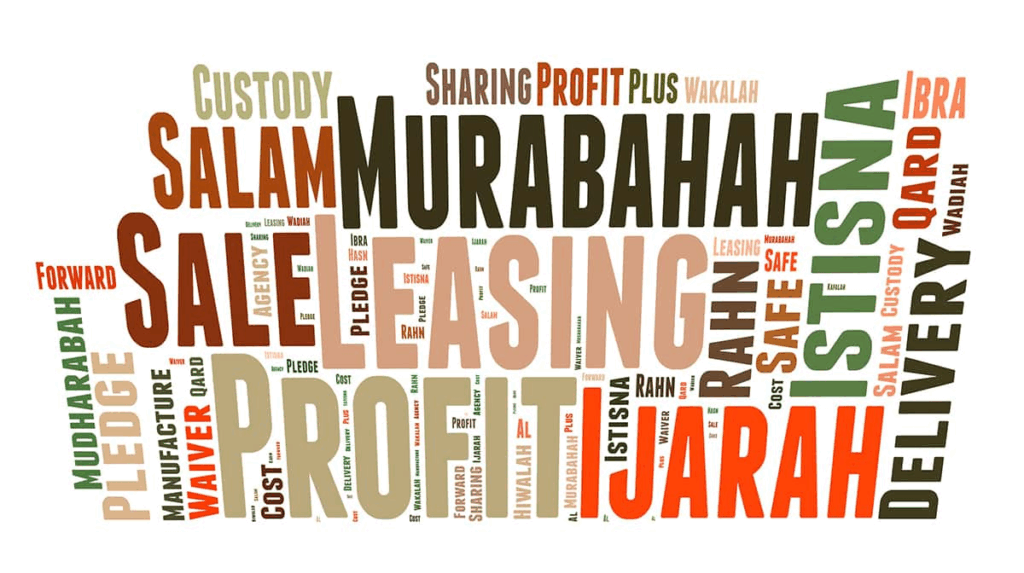
Key Contracts in Islamic Finance (Financial Instruments)
- Murabaha (Cost-Plus Sale)
Definition:
An institute buys an asset and sells it to the customer at a known profit margin. The price is fixed in advance and does not involve interest. There is also share equity/risk, which means if the assets loses value, then the institute also suffers, not just the customer.
Example:
You want to buy a laptop. The bank buys it for £1,000 and sells it to you for £1,200, payable in 12 monthly instalments. The £200 profit is agreed upfront.
- Mudarabah (Profit-Sharing Partnership)
Definition:
One party provides the capital (called Rab al-Mal), and the other provides expertise and management (called Mudarib). Profits are shared as agreed, but losses are borne only by the capital provider unless the manager is negligent.
Example:
You invest £10,000 in a business run by a skilled entrepreneur. You agree to split profits 60/40. If the business makes £5,000 profit, you get £3,000. If it loses money, you bear the loss.
- Musharakah (Joint Venture)
Definition:
All partners contribute capital and may also contribute skills. Profits and losses are shared based on each party’s contribution.
Example:
You and a friend each invest £5,000 in a food truck. You both share profits and losses equally, or in any agreed ratio.
- Ijara (Leasing)
Definition:
An asset is leased to a client for a fixed rent. Ownership remains with the lessor, but the lessee uses the asset.
Example:
A bank buys a car and leases it to you for 3 years. You pay monthly rent. At the end, you may have the option to buy the car.
- Salam (Advance Payment Contract)
Definition:
Payment is made in advance for goods that will be delivered later. Common in agriculture or commodities.
Example:
You pay a farmer £1,000 today for 100 sacks of wheat to be delivered in 3 months.
- Istisna’ (Manufacturing/Construction Contract)
Definition:
A buyer commissions a product (like a building or machine) to be made and delivered in the future. Payment can be made in stages.
Example:
You contract a builder to construct a house. You pay in instalments as the work progresses.
- Wakala (Agency Agreement)
Definition:
You appoint someone (an agent) to act on your behalf, often to invest your money in Shari’ah -compliant ways.
Example:
You give £5,000 to a bank to invest in halal businesses. The bank acts as your agent and charges a fee.
- Sukuk (Islamic Bonds)
Definition:
Sukuk are investment certificates backed by tangible assets. Unlike conventional bonds, they don’t pay interest but share profits from the asset.
Example:
You buy a Sukuk linked to a toll road. You earn a share of the toll revenue instead of interest.
- Takaful (Islamic Insurance)
Definition:
A cooperative system where members contribute to a pool to support each other in times of need. It’s based on mutual assistance, not profit.
Example:
You join a Takaful health plan. If you fall ill, the pool covers your medical costs. If others fall ill, your contributions help them.
What does an Islamic Economics System look like?
An Islamic economic system is built on the simple idea that everything we have, money, land, time, skill, is a trust from Allah. We don’t own these things in the absolute sense; we’re caretakers who must use them wisely and fairly. The system isn’t just about rules or money, it’s about creating a way of life where wealth benefits everyone, not just a few. It aims to bring balance between personal ambition and social responsibility. You’re free to work, trade, and build your business, but you must do it with honesty and care for others. In Islam, money can’t just make more money by itself. It should come from real effort, real trade, and real value. Wealth shouldn’t sit in one place or in the hands of a few people; it should flow through society, supporting those in need and keeping the community strong.
Life is a test, and part of that test is how we deal with wealth. Rizq comes only from Allah, but we’re expected to go out and earn it through honest work. So the goal of the Islamic economic system isn’t just to make people richer. It’s to make society fairer, to keep our hearts clean from greed, and to remind us that success isn’t measured by how much we own, but by how we use what we’ve been given. It turns everyday work and trade into acts of faith, connecting our worldly effort with our spiritual purpose.
What does a Islamic Banking System look like?
An Islamic banking system works on the same basic idea as the wider Islamic economy: money should serve people, not control them. It avoids interest completely, since earning money just by lending it out without sharing any risk or effort is seen as unjust. Instead, Islamic banks operate through partnership and trade-based contracts. That means they make profits by actually investing in real assets, businesses, or projects, not through speculation or debt creation.
For example, if someone wants to buy a house, the bank might buy it first and then sell it to them at an agreed markup, letting them pay in instalments. Or if a business needs funding, the bank and business can become partners, sharing both profit and loss. Depositors, too, share in the bank’s returns rather than receiving fixed interest. This keeps the system tied to real economic activity, money must be earned through value creation, not through money itself. It also emphasises ethical responsibility. Banks can’t invest in industries that harm society, like gambling, alcohol, or arms dealing. The goal is not just financial growth but moral growth too.
What does an Islamic Stock/Share Market look like?
An Islamic stock market looks a lot like a regular one on the surface, people buy and sell shares of companies, but the rules behind it are very different. Every company listed must operate in a halal way, meaning it can’t deal in things like alcohol, gambling, interest-based finance, or anything that causes harm or injustice. It also must avoid excessive uncertainty or speculation, since gambling on price movements goes against Islamic principles.
When a Muslim buys a share in a company, they become a part-owner, not just a gambler hoping for quick profit. That means they share in both the company’s risk and reward. The profits they receive are tied to the actual performance of the business, not guaranteed in advance.
Islamic stock markets also promote transparency and accountability. Companies have to disclose how they earn and spend their money so investors know they’re putting their wealth into something clean and productive. There are also Shariah boards, groups of scholars who oversee and certify which stocks are permissible.
Trader/Merchant/Business Man
Finally it is said one of the most virtuous occupations is trade, because this is when you are tested most. This could relate to your personal conduct, your imaan, vices, ibaadat. If you get it right, high maqam. But it also means you are open many avenues of sin. You are the one in society creating wealth, jobs, trade, circulating money, and also supporting the needy.
How does the Fiqh of Islamic Finance work?
Generally, Fiqh can be divided into Ibaadat (relationship with the creator) and Muamaalaat (relationship with the creation). Ibadaat is basically the five pillars. Muamaalaat is social relations. When we look at fiqh books, they usually split the fiqh into four parts:
- Al-ʿIbādāt – Acts of worship
- Al-Muʿāmalāt – Specifically financial dealings
- Al-Munākaḥāt – Marriage & Divorce and related
- Al-Jināyāt – Criminal law
There is a question I have on Riba. If a company are charging interest only. And it’s actually interest by name .. either because it is a good marketing tool (easier to explain the finance to customers) or because it may compound and you can charge a higher amount or because you can charge the cusomter a higher amount but make it feel affordable to them. But the reason they charge interest is to cover the overheads and make some profit.
The car is £40, 000. Their costs are £2,000 and they want to make £3,000 profit. They can charge £45,000 for the car. And since you cannot afford the £40k, and due to inflation they will make a loss in the 5 years you take to pay them back. So instead they sell for £40, 000 + 5% interest. To cover their expenses, profit and loss revenue due to money not being available and inflation.
It is hard to explain.. what Im getting at is sometimes the company are not charging riba..as in looking to make more money or punish the debtor but simply recoup their own costs and make some profit.
Would we allow this?